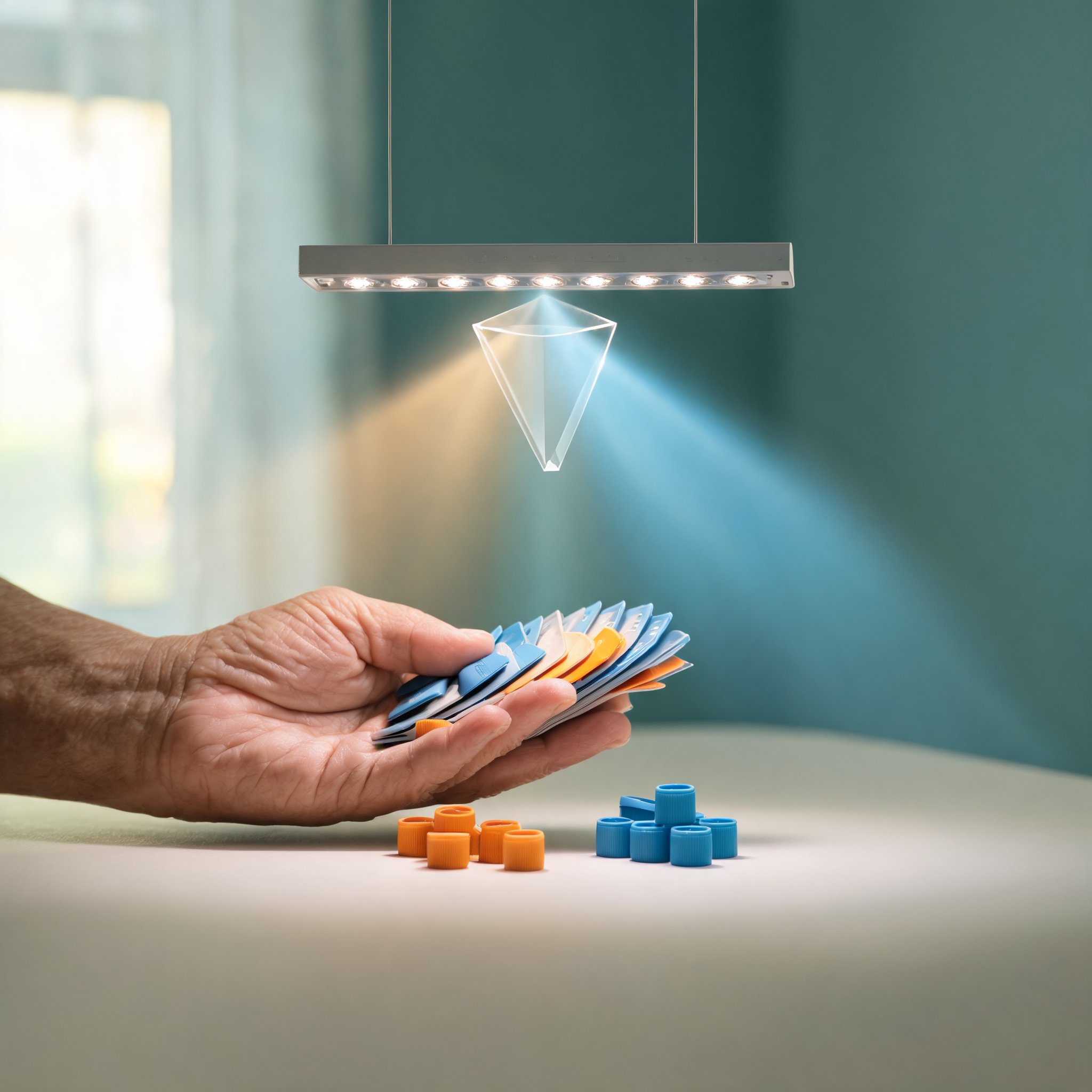
In senior-living lighting, an 80 CRI luminaire can invite questions. A study published in Optics Express offers a counterexample: a custom-mixed LED spectrum rated only 80 CRI helped people in their 70s and 80s sort colors more accurately than a simulated D50 daylight reference rated 97. The lower score was not the objective; the spectrum had been adjusted for age-related changes in vision.
Why standard metrics miss the aging eye
The research comes from Fudan University in Shanghai, with two Opple Lighting employees among its eight authors. It starts from a familiar problem: the eye’s lens yellows with age and filters out short-wavelength light. Ra and TM-30, the color metrics specifiers use, are calculated with a fixed standard observer that makes no allowance for lens aging, even though the CIE’s 2006 physiological model includes an age parameter.
The team modeled the color response of aging eyes and created two metrics. One estimates how much lost color discrimination a spectrum recovers for an older viewer; the other measures color fidelity against a 32-year-old’s perception. The researchers screened 11,541 candidate spectra from a 16-channel LED luminaire, all at 5000 K and Ra of at least 80. Two were tested against the D50 reference. P1 prioritized discrimination at Ra 80; P2 balanced discrimination and fidelity at Ra 90. When the candidates were re-ranked using the conventional standard observer, P1 lost its top position. A light that ranks highest on a specification sheet may not be the one an older viewer ranks highest.
What the participant test found
The viewing test involved 34 participants aged 70 and older, with a mean age of 81.7. They sorted colored caps from the Farnsworth-Munsell 100 Hue test in a viewing booth at 300 lux. Mean error scores fell from 79.2 under the reference to 62.4 under P1 and 65.0 under P2; both drops were statistically significant. Color discrimination improved for 26 of 34 participants (76.5%) under P1 and 22 of 34 (64.7%) under P2. The difference between the two optimized spectra was not significant.
On whether fruits and vegetables looked natural, 28 participants said yes under P1, compared with 26 under both the reference and P2. A two-person difference proves little, but it suggests the lower Ra cost P1 nothing in perceived naturalness.
Limits, funding and replication
The sample was small. People with advanced cataracts, glaucoma or macular degeneration were excluded, which removes many of the residents a memory-care designer lights for. Chromaticity between the reference and test lights was not perfectly matched, and the naturalness question was a simple yes or no. The authors also warn against reading 300 lux as a recommendation.
Opple financially supported the study, according to the paper’s disclosures. The paper names no product, but a news release distributed through Optica, the journal’s publisher, says Opple is working to translate the findings into lighting products. The work therefore sits between academic research and early product development. Because the underlying data is available only on request, independent replication will be important.
From a lab spectrum to a specification
The method requires at least four independently controlled LED channels. Fixtures that mix several LED channels are uncommon in care-facility procurement. Most healthcare and senior-living products marketed as tunable change color temperature using two channels, which would not reproduce these spectra. That gap is an inference from the study’s method, not a claim in the paper.
For lighting people in senior living and healthcare, the study raises a pointed question. Standard industry metrics do not account for the aging eye, and a growing share of building occupants are well past middle age. If a tuned spectrum can help residents read a medication label or judge whether food has spoiled, the question becomes how fast such evidence enters specifications and product lines, and which manufacturers get there first.
What the result does and does not prove
It does not prove that 80 CRI is better than 97 CRI in general, nor that the spectra produce measurable benefits outside the test. It shows that a fixed standard observer can rank spectra differently from older viewers, and that a spectrum optimized for those viewers can improve color sorting in a controlled setting. Larger trials, better chromaticity matching, inclusion of people with common age-related eye disease and field validation would be needed before specifications change. For now, the result does not justify discarding Ra or TM-30; it exposes their blind spot.