The Canadian Sphagnum Peat Moss Association's Sept. 17 report, covering conditions through Aug. 31, shows wide regional variation in this season's peat extraction. Alberta reached 56% of expected extraction, Manitoba 79%, Saskatchewan 90%, Québec's North and South Shores 77%, Southern New Brunswick 70%, Northern New Brunswick 85%, and Ontario 90%. Prince Edward Island, Newfoundland and Labrador, and Nova Scotia were reported as significantly below expected levels.
CSPMA attributes much of the shortfall to wet weather, and says careful inventory management should allow producers to meet customer needs. The association does not frame the situation as a peat shortage, and that distinction shapes how the figures should be read.
What "Expected Extraction" Measures
CSPMA's "expected extraction" is not a measure of how much available peatland was harvested. It reflects the amount producers calculated they needed for the season: market requirements plus the desired year-end inventory buffer, minus inventory carried into 2026. A below-expected figure therefore signals a gap against a plan rather than a direct tally of what the ground yielded.
The more useful question for growers, the column argues, is not whether peat will run out, but how resilient a growing-media strategy is when a depended-on material becomes harder or more expensive to secure.
The Risk Is Bigger Than Peat
Peat is only one part of a broader supply picture. Climate affects harvest and biomass availability, while labor affects harvesting, processing and transportation. Freight can change the economics of a material long before its FOB price moves.
Transportation is particularly difficult now. The Wall Street Journal reported in late September that U.S. contract trucking rates averaged $3.11 per mile in August, including fuel surcharges, up 29% from a year earlier. Diesel, driver availability, rail surcharges and ocean freight all add volatility. For a bulky input such as growing media, delivered cost can change a sourcing decision very quickly.
Dr. Charlie Hall has made a similar point from the broader grower-cost perspective. In a recent Greenhouse Grower interview, Hall emphasized supply-chain agility, backup suppliers and working-capital discipline as growers plan for 2027. His Index of Prices Paid by Growers is useful, the author notes, because the cheapest input on paper is not necessarily the lowest-risk or lowest-cost decision once freight, inventory and operational impacts are included.
The author argues that growers should stop treating raw-material selection as a once-a-year purchasing exercise and instead treat it as a risk-management and production-design decision.
Start With Character, Then Back Into Ingredients
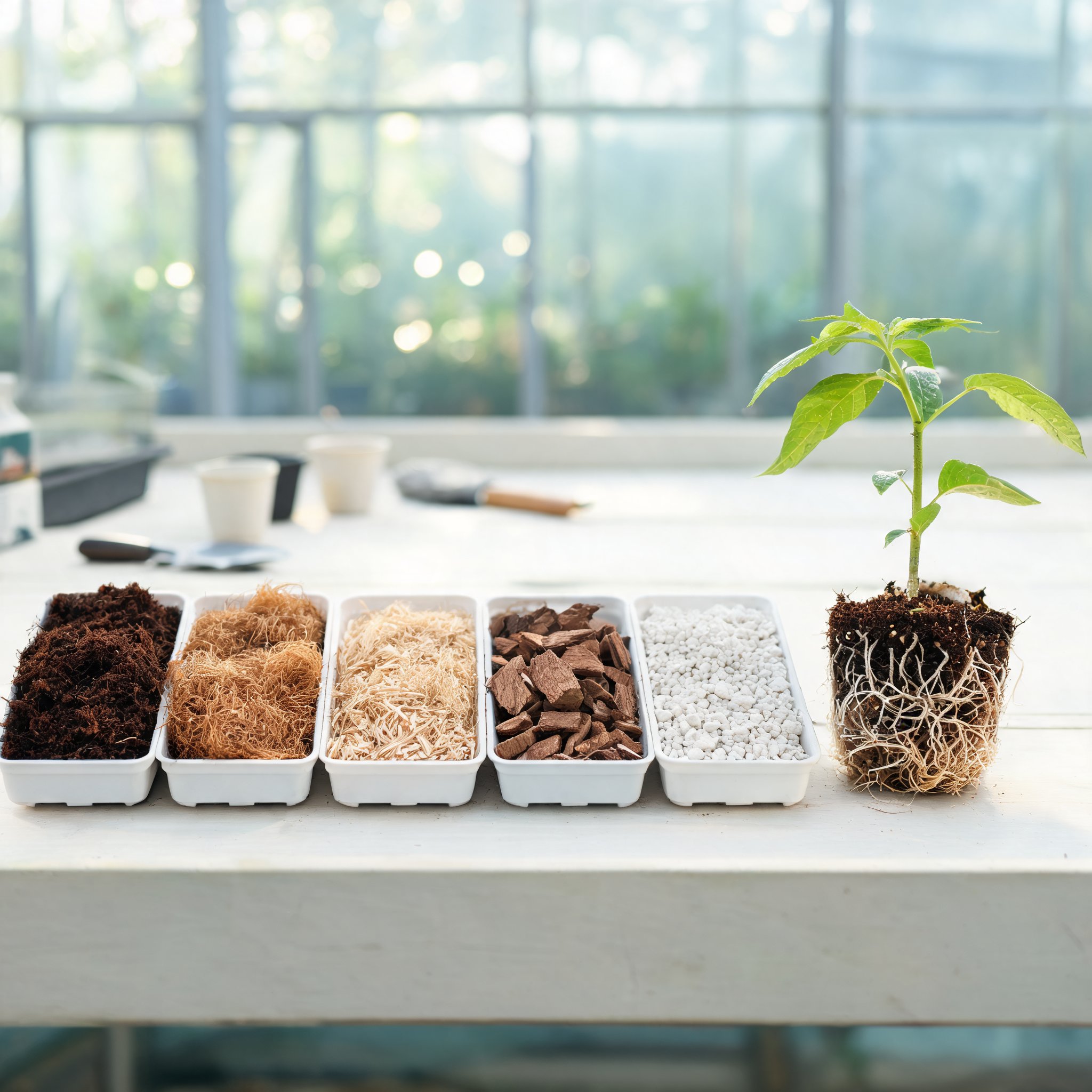
Growing media is often built in the opposite direction, starting with what is available — peat, coir, bark, wood fiber, perlite or another familiar component — and building a mix around those ingredients. A more logical starting point is the crop: what character the root zone needs, how much water holding and air porosity are required, what structural stability the crop cycle demands, how the material must rewet, what buffering and chemistry the crop and irrigation program can tolerate, and how uniform it must be for automation. Once those requirements are clear, the ingredients and percentages follow.
The raw-material toolbox is also getting larger. Wageningen University & Research's 2026 work on the future of growing media identifies market-accepted materials such as coir, coniferous wood fiber, bark, compost and perlite, but also less familiar candidates including other plant fibers, biochars, co-composts and reused growing media. The researchers note that many new materials require processing, sanitization and stabilization before they can become reliable horticultural inputs. Availability, in other words, is not the same as suitability — but suitability is increasingly something that can be engineered.
Revisit Materials Passed Over
Processing technology has improved across coir, wood fiber, bark and other biomass streams. Materials that were too inconsistent, too wet, too coarse, too salty, too difficult to handle or simply too expensive several years ago may deserve another look, as may regional agricultural residues that can be cleaned, screened, fiberized, composted or otherwise stabilized into consistent ingredients.
The author does not suggest replacing a proven substrate simply because something new exists, but rather knowing what else is out there before it is needed. A material does not have to reach 30% or 40% of a formulation to be useful; in some systems a 5% or 10% inclusion may be enough to change cost, water behavior, structure, rewetting or supply exposure. The right rate is a crop and system question rather than a universal prescription, and any new component needs to be trialed and validated before commercial adoption.
Local and Global as a Portfolio
Regional materials can reduce transportation exposure and add flexibility, especially when they can be processed near the point of use, but "local" is not automatically better, just as "imported" is not automatically risky. Coir travels a long distance yet can offer characteristics that are difficult to reproduce with some local materials; peat remains an extraordinarily important and effective component; wood fiber and bark can contribute strongly where feedstock and processing are right.
The more resilient strategy is likely a portfolio: dependable core materials, strong supplier relationships, some regional options, some globally sourced options, and enough formulation knowledge to adjust without losing the root-zone character the crop requires.
Using This Season as a Planning Signal
The lesson from this year's Canadian peat harvest is not that growers should move away from peat — CSPMA itself says inventory management should allow producers to meet customer requirements. The lesson is that the conditions behind raw materials can change quickly while crops still have to be produced on schedule. Weather, labor, freight, tariffs and supply-chain disruptions over recent years have shown that yesterday's dependable supply pattern is not guaranteed to remain tomorrow's.
Demand is growing, too. Wageningen research projects global growing-media demand rising substantially toward 2050, which implies the industry will need a broader basket of materials and more processing capacity rather than a different winner in the peat-versus-coir-versus-wood-fiber debate.
For 2027 planning, the author suggests a few practical questions: which raw materials are most exposed in a current formulation, what their true delivered cost is, which characteristics are essential to the crop, what other ingredients could deliver part of that function, and which of those should be trialed now. The best time to build flexibility into a growing-media program, the column concludes, is while choices still exist.
Jennifer Neujahr is the former Director of Horticulture Business for Profile Products and, with Ted Buis, co-founder of Next Step Solutions, a growth accelerator focused on horticulture and AgTech.