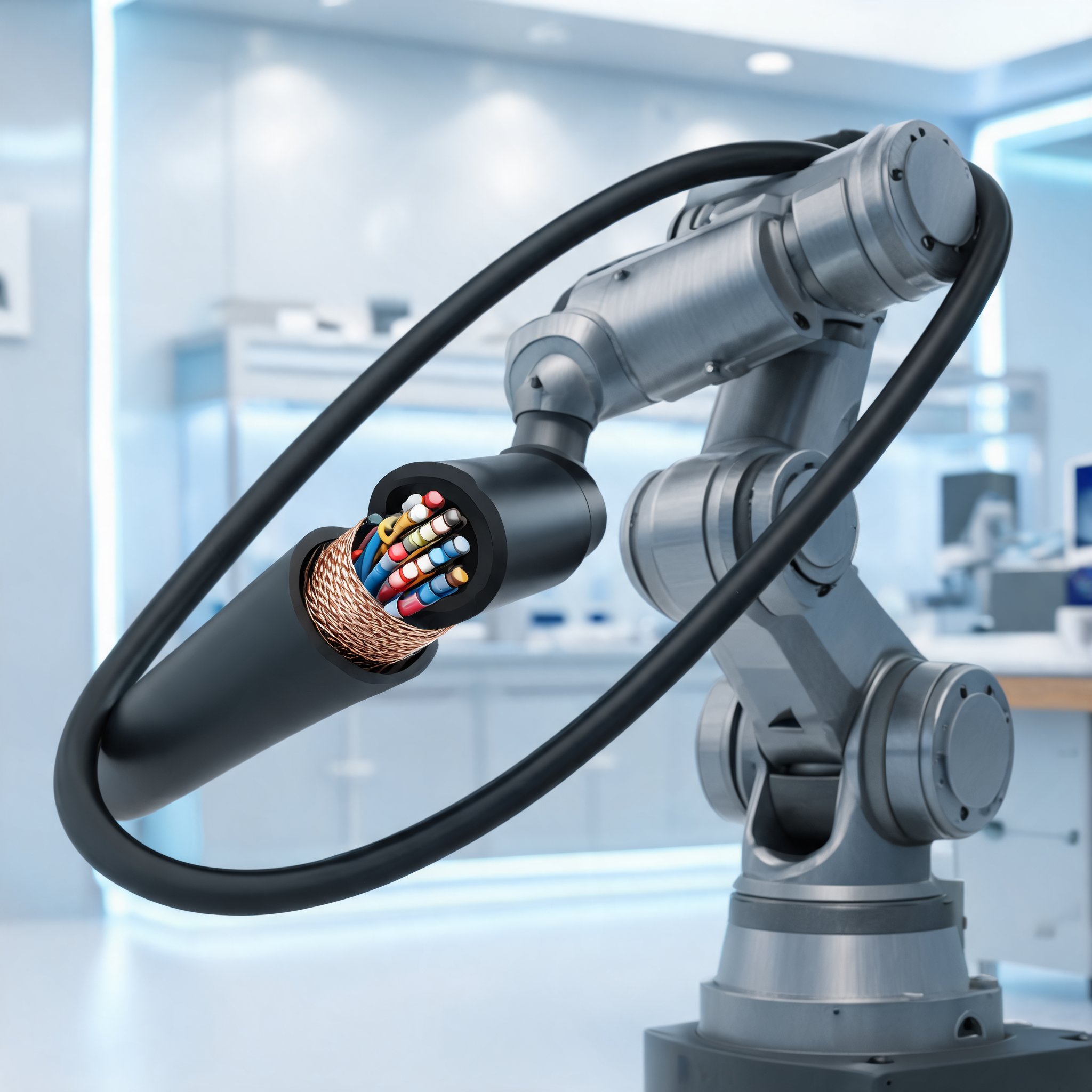
Igus has expanded its CFROBOT8.PLUS robot cable family with a DeviceNet cable designed for dynamic robotic applications that involve up to ±360° per meter of torsion. The company says the family is engineered for up to 10 million torsional cycles, using a specialized shield design intended to remain flexible during continuous robotic movement.
The new cable also has a reduced outer diameter, as much as 21 percent smaller than previous CFROBOT8 models, according to Igus. That change is intended to help route the cable in tight spaces. A tinned-copper braided shield is used to help maintain signal integrity under demanding conditions, while oil and UV resistance support use in indoor and outdoor environments.
Applications and family coverage
Igus lists six-axis robots, handling systems, machine tools, linear and lead screw systems, and other equipment with continuous torsional movement among the cable's intended applications. The CFROBOT8.PLUS family also includes versions for PROFINET, PROFIBUS, CAN bus and Ethernet applications up to CAT7, giving users options across industrial communication systems.
Laboratory testing
Like other chainflex cables, CFROBOT8.PLUS products are tested in Igus's 5,500-square-meter laboratory under simulated real-world robotic motion. The company says testing has demonstrated reliable electrical performance through more than 15 million cycles. These figures describe Igus's testing and product specifications; they do not establish performance in every installed system.