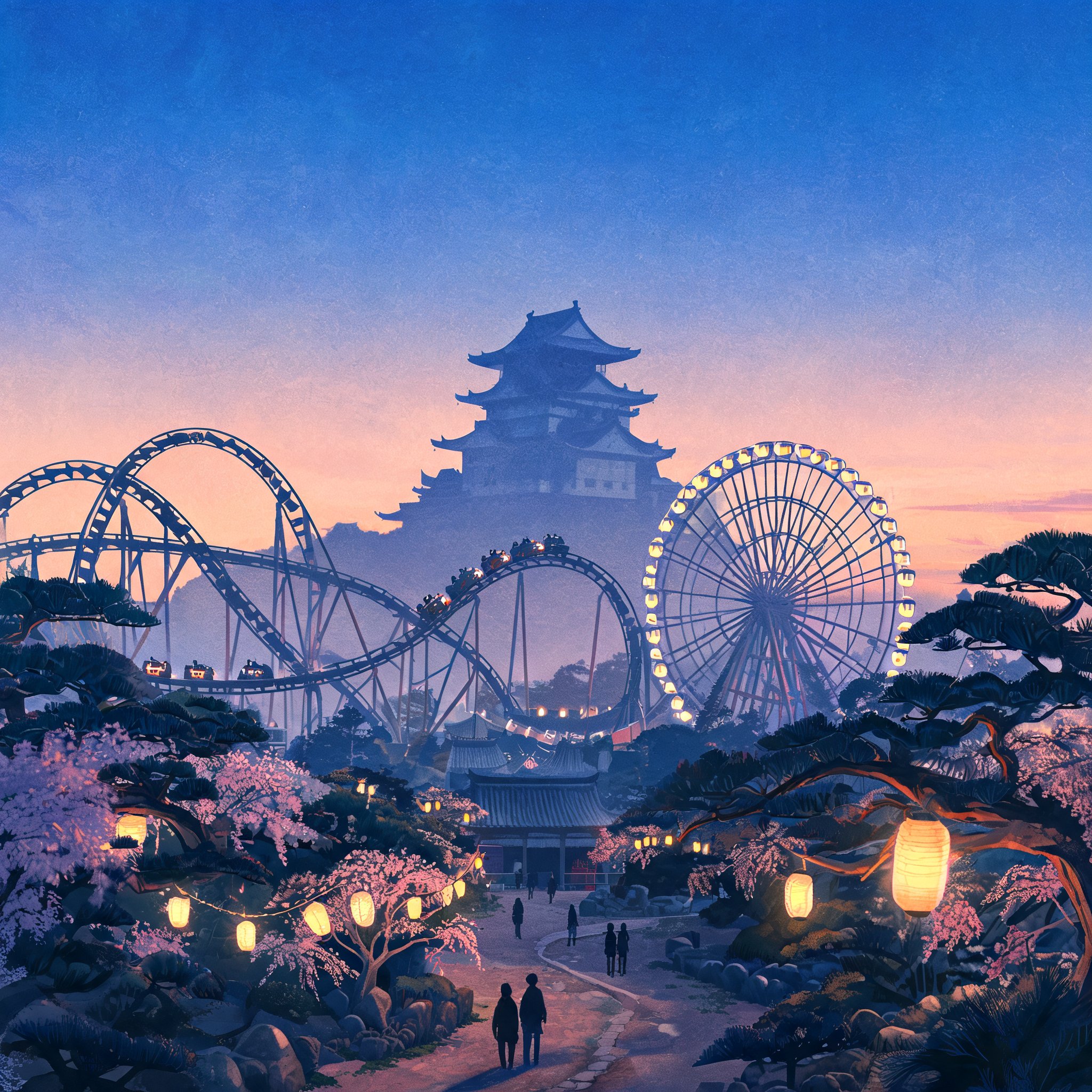
Japan welcomed a record 42.7 million international visitors in 2025, and its theme parks remain a major draw. The country’s lineup ranges from global destination resorts to regional parks built around characters, coasters and culture. Here are 18 parks, from Tokyo Disneyland to PokéPark Kanto.
Major destination resorts
- Universal Studios Japan in Osaka opened in 2001 with Harry Potter, Jurassic Park and Minions areas. It opened Super Nintendo World in 2021, added Donkey Kong Country in 2024 and announced a 2026 expansion worth up to 300 billion yen on 60,000 square metres.
- Tokyo Disneyland opened on 15 April 1983 as the first Disney park outside the US. Its seven lands include Fantasyland and Tomorrowland. A 100 billion yen ($630 million) Tomorrowland transformation will add Space Mountain Earthrise and Sugar Rush: Sweet Rescue, with the new Space Mountain replacing the original in 2027.
- Tokyo DisneySea opened in September 2001 across 49 hectares with seven themed ports. Its 2024 Fantasy Springs expansion, costing $2.2 billion, added worlds inspired by Frozen, Tangled and Peter Pan, including Arendelle Castle, Rapunzel’s Tower and Neverland.
- Ghibli Park in Aichi presents Studio Ghibli films across five areas completed in 2024. It has no major thrill rides, but features Howl’s Moving Castle, a Totoro playground with Satsuki and Mei’s House, and Catbus vehicles; a Nausicaä indoor area is planned.
Character and film-based parks
- Sanrio Puroland is an indoor Tokyo park opened in 1990, featuring Hello Kitty, My Melody and Cinnamoroll through shows, parades and rides. Alterface created Cinnamoroll’s Little Big Adventure for its Discovery Theatre in 2024.
- Fuji-Q Highland, opened in 1968 in Yamanashi, is known for Fujiyama, Eejanaika and Takabisha coasters and Mount Fuji views. It hosts collaborations with Demon Slayer, Evangelion, Gundam and Pokémon and is 1.5–2 hours from Tokyo.
- Nagashima Spa Land in Mie Prefecture opened in 1966 and has 13 operating coasters, more than any other Japanese amusement park. Steel Dragon 2000 ranks among the world’s longest. The wider resort adds a water park, hot springs and Nabana no Sato.
- Huis Ten Bosch opened in 1992 in Nagasaki and, at about 152 hectares, is Japan’s largest theme park by area. It recreates a Dutch town, opened Japan’s first premium flying theatre in 2025 and includes the world’s only Miffy area, Miffy Wonder Square.
- Legoland Japan opened in Nagoya in April 2017 and is operated by Merlin Entertainments. Miniland Japan recreates Tokyo, Kyoto, Mount Fuji, Hiroshima and Nagoya with more than 10 million Lego bricks; Lego Ninjago World is a Japan-exclusive attraction.
- PokéPark Kanto opened in February 2026 at Yomiuriland in Tokyo as the world’s first permanent outdoor Pokémon attraction. The 26,000-square-metre park has more than 600 Pokémon across Pokémon Forest and Sedge Town, plus attractions and a parade. Tickets include Yomiuriland admission, but rides are separate.
- Yomiuriland in Tokyo’s Tama Hills has more than 40 rides, including the 110 km/h Bandit coaster and the manufacturing-inspired Goodjoba!! area. It attracted around 2.4 million visitors in 2024 and marked its 60th anniversary that year.
- Moominvalley Park opened in March 2019 in Saitama as the world’s second Moomin-themed park and the first outside Finland. It recreates Moomin settings through themed buildings, scenery and shops across four areas, with Finnish-inspired design.
- Edo Wonderland Nikko Edomura is a 49.5-hectare cultural park in Tochigi that recreates an Edo-period town. Visitors can dress as samurai or ninjas and watch theatre, ninja performances and parades; mascot Nyanmage is a samurai cat.
- Asakusa Hanayashiki, established in 1853, is considered Japan’s oldest amusement park. In Tokyo’s Asakusa district, it has Japan’s oldest surviving roller coaster, built in 1953, plus family rides, a ninja area, swordplay and a haunted house.
- Sylvanian Park in Ibaraki is a Sylvanian Families-themed attraction within Komorebi Mori no Ibaraido. It offers themed buildings, character appearances, activities, photo opportunities and a merchandise shop, and can be combined with other family attractions.
- Greenland in Kumamoto is among Kyushu’s largest parks and sits within the 300-hectare Greenland Resort. Previously Mitsui Greenland, it has around 80 attractions, a 105m Rainbow Ferris wheel and coasters including the suspended NIO and the seated-and-standing Milky Way.
- Sanrio Harmonyland in Oita Prefecture is the outdoor sister park to Puroland, with Sanrio characters in shows, parades and attractions. In 2026 it opened Nakayoku Lab, which includes the Sky Pal Collection AR experience and an AI voice-guided tour.
- Hirakata Park, Osaka’s oldest amusement park, dates to 1910 and attracts around 1.3 million visitors a year. Its 45 attractions include the 696m wooden coaster Elf and the 1.3km Red Falcon, and it hosts collaborations with Sanrio, Gintama and Ultraman.