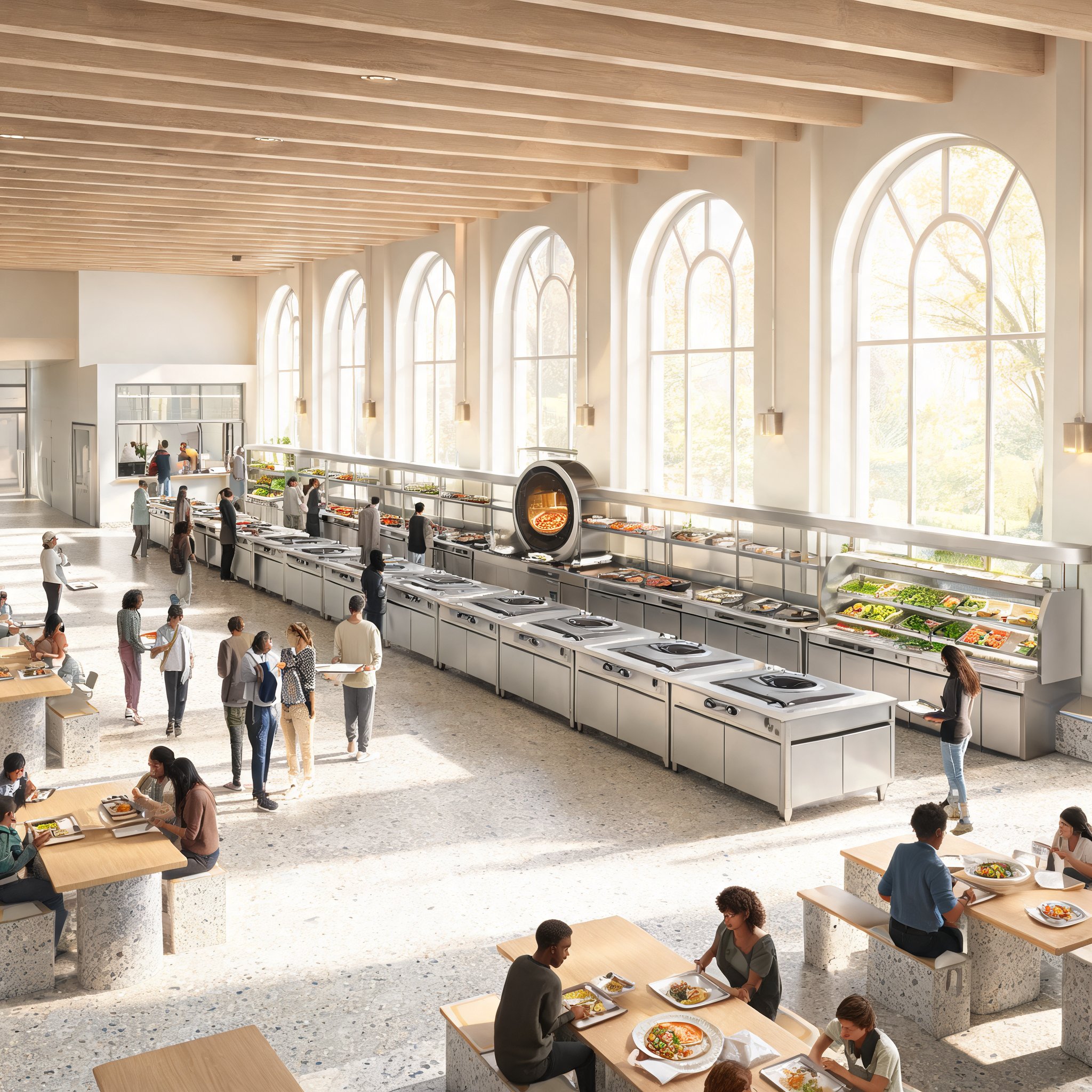
Texas Christian University has completed a major redesign of its Market Square dining facility, now called BLUU Dining in the Brown-Lupton University Union, with the aim of creating a destination for students and supporting growth in meal plan participation. The facility opened in August 2026 as part of a $17 million overhaul of the union.
The reworked dining hall covers about 13,000 square feet, with another 4,500 square feet for food platforms and back-of-house areas. It seats 550 indoors and 120 on a patio. BLUU Dining has eight food platforms, including a to-go window called Dash that opens into the entrance hallway so students can pick up a premade sandwich or salad without entering the servery.
Meal counts rise after reopening
Less than two months after opening, BLUU Dining was averaging 4,000 meals per day, according to Jude Kiah, associate vice chancellor for student affairs business and operations. That was double the meal counts recorded when the facility closed for renovation in December 2025. The peak day reached about 5,700 meals, and Kiah said the operation could probably produce 8,000 meals per day if needed.
Planning began in 2022 with student surveys. Kiah said the data showed students were dissatisfied with the facility rather than the food and viewed the old dining hall as a self-serve cafeteria with premade food. The research also found that students valued made-to-order food over speed of service and were willing to wait for customized meals. Kiah said the team conducted at least six focus groups and surveys before trusting the results. In one case, a bowl queue was 15 deep and the last person was served in four minutes and 30 seconds.
Layout and equipment changes
The design team moved the salad, deli and to-go platform away from the main serving area, freeing space for other platforms and creating a bright area near a wall of windows overlooking the campus and stadium. A wide service corridor with individual entrances to each platform replaced a narrow passageway, reducing competition for space. The support kitchen received new epoxy flooring and a one-for-one replacement of most equipment, while an 800-square-foot walk-in cooler allows pallets to be rolled in, unloaded onto carts and distributed more efficiently. Webb Foodservice Design helped confirm equipment lists and layouts.
Equipment choices emphasized capacity, flexibility and maintainability. A rotating pizza oven can produce 116 pizzas per hour and bake casserettes on a lower level without requiring workers to reach into a 550-degree oven. Other selected items include a customer-facing soft-serve machine, a round griddle that also works as a plancha, and a pasta station that can switch to breakfast service. Kiah and Miles Oller, director of facilities and operations, said the team generally favored durable, low-tech equipment that staff can operate and maintain easily.
Growth plans
TCU opened East End, a dining hall on the opposite side of campus, in January 2025. The same dining team led both projects, with menu support from Sodexo’s One & All college dining program. Meal plan enrollment stands at 6,300 and is expected to exceed 8,000 in the coming year. The university plans to add 2,500 campus beds next fall. Kiah said BLUU Dining needed to serve as a stronger anchor than East End and is already doing so; the next task is to operate it consistently.